
What Does Low-Maintenance Landscaping in Florida Really Mean?
Published on August 25, 2026
If there is one request we hear over and over from homeowners in the Florida Panhandle, it’s this:
“I just want something low maintenance.”
We get it. Whether you live here full-time, own a vacation home, or simply don’t want to spend every weekend working in the yard, nobody wants a landscape that constantly demands attention.
The problem is that some of the things that look low maintenance aren’t necessarily the easiest landscapes to maintain.
Rock instead of mulch. Sand instead of grass. A “natural” yard that only gets serviced once a month.
They all sound simple.
But Florida has other plans.
After years of installing and maintaining landscapes along the Florida Panhandle, there’s one thing we’ve learned:
Every landscape requires maintenance. The question is what kind, how often, and how much.
The Rock Myth: “If I Put Down Rock, I Won’t Have Weeds”
Rock can be a beautiful addition to a Florida landscape. We use it regularly in the right applications, especially when it complements a coastal design, hardscape, drainage area, or architectural style.
But rock isn’t a maintenance plan.
One of the most common reasons homeowners choose rock is because they assume replacing mulch with rock will eliminate weeds.
Unfortunately, weeds didn’t get that memo.
Landscape fabric can help suppress weeds initially, but over time leaves, grass clippings, pollen, dirt, pine straw, and other organic material settle between the rocks.
Eventually, that material begins breaking down and creating a thin layer of organic matter on top of the landscape fabric.
And weeds can grow in it.
Now the landscape still requires spraying or hand weeding, while also needing to be blown out, cleaned, edged, and occasionally raked to keep the rock where it belongs.
Rock can absolutely be the right choice.
Just don’t choose it because someone told you that you’ll never have to maintain the area again.
Rock is a design material. It isn’t a maintenance plan.
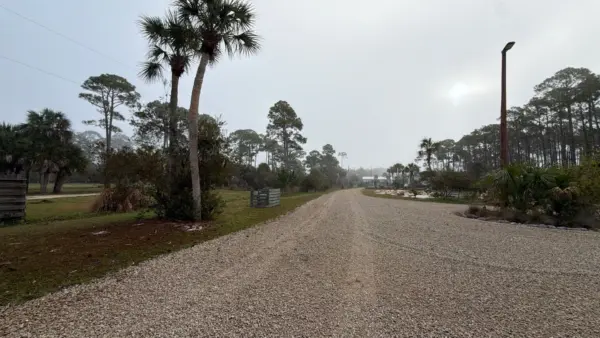
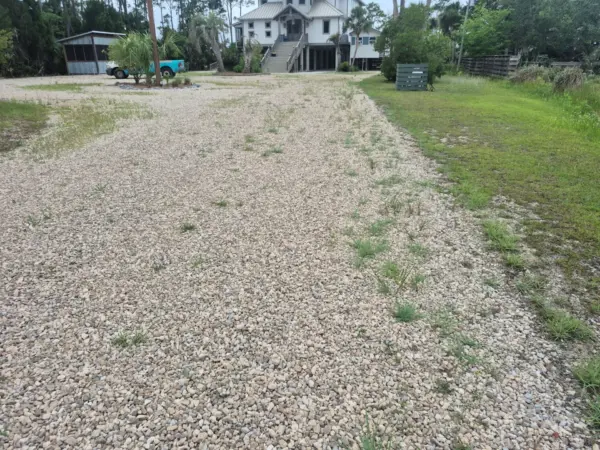
These photos are of the same driveway taken less than two months apart!
The Sand-Yard Myth
This one is especially common along the coast.
A homeowner looks at a clean, sandy yard and thinks:
“Why would I plant grass? I’ll just leave it sand. That should be practically maintenance-free.”
It makes sense in theory.
In reality, sand doesn’t stay just sand in Florida.
Our warm temperatures, abundant rainfall, long growing season, and seemingly endless supply of weed seeds mean that an open sandy area will eventually grow something.
Usually lots of somethings.
Keeping a sand yard looking like clean, open sand requires ongoing work. Depending on the property, that may include weed control, hand pulling, raking, blowing debris, removing unwanted grasses, and regularly cleaning the area.
Without that maintenance, the sand gradually becomes a mixture of weeds, grasses, leaves, pine straw, and whatever else Florida decides to grow there.
And here’s the part that surprises many homeowners:
Maintaining a clean sand yard can take just as much time—and sometimes more time—than mowing a lawn.
Think about the difference.
A properly designed turf area can be efficiently mowed, edged, and blown.
A sand yard may need to be walked, inspected, sprayed where appropriate, hand weeded, raked, and cleaned.
Removing the grass doesn’t necessarily remove the labor.
It simply changes the type of labor required.
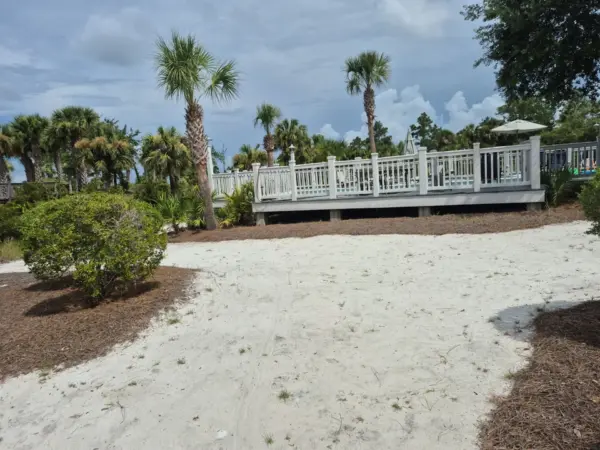
We maintain this property weekly during season and there is still weed growth that happens between visits!
“I Want It to Look Natural”
We hear this one often, too, and there’s absolutely nothing wrong with wanting a natural-looking Florida landscape.
In fact, we love landscapes that feel like they belong here.
But there is an important distinction between a natural landscape and an unmaintained landscape.
An intentional natural landscape may incorporate native or Florida-friendly plants, ornamental grasses, palms, groundcovers, natural groupings, and less formal pruning.
It still has structure.
It still has defined spaces.
And it still requires maintenance.
Without regular attention, unwanted weeds and grasses don’t politely stop growing because we’re going for a natural look.
Florida grows quickly—especially during our warm, rainy months.
Which brings us to another common misconception.
“Can You Just Come Once a Month?”
Service frequency has a huge impact on what a landscape looks like.
We occasionally have homeowners who want a natural property and assume that once-a-month service will be enough to keep everything under control.
Then they arrive at their home several weeks later and are surprised to find weeds that are knee-high.
That’s not necessarily because the property wasn’t maintained properly during the previous visit.
It’s because Florida kept growing for the next four weeks.
During our peak growing season, a tremendous amount can happen in a month.
Rainfall, heat, and sunshine can turn tiny weeds into mature plants surprisingly quickly. Grass grows. Edges disappear. Vines spread. Debris accumulates.
A low-maintenance landscape and a low-frequency maintenance schedule are not necessarily the same thing.
Sometimes a property that takes a relatively short amount of time to maintain regularly can require significantly more work when it’s allowed to grow for several weeks between visits.
Sometimes Grass Is Actually the Lower-Maintenance Option
This one surprises people.
There are absolutely properties where reducing turf makes sense.
But grass isn’t automatically the enemy of a low-maintenance landscape.
In an open area with the right conditions, healthy turf can actually be one of the most efficient surfaces for a professional landscape crew to maintain.
We can mow it.
We can edge it.
We can blow it.
Done.
Compare that with the same area covered in sand or decorative rock where weeds have to be identified and treated, debris has to be removed, material may need to be raked back into place, and certain areas may require hand weeding.
Sometimes the landscape that looks simpler actually requires more manual labor.
That’s why we don’t believe there is one material that automatically makes a property “low maintenance.”
So What Does Low Maintenance Actually Look Like?
A truly low-maintenance landscape isn’t one where nothing grows.
It’s one that has been intentionally designed to make ongoing maintenance simpler, more efficient, and more predictable.
That starts with putting the right things in the right places.
For a Florida landscape, that may mean:
- Choosing plants that tolerate our heat, humidity, soil conditions, and coastal environment.
- Selecting plants based on their mature size, so they don’t constantly need to be cut back to fit the space.
- Using larger groupings of appropriate plants rather than filling a landscape with dozens of varieties that all require different care.
- Creating defined beds and edges that are easy to maintain.
- Using turf in areas where turf is practical and efficient.
- Using rock where rock serves a purpose—not simply because it sounds maintenance-free.
- Using mulch or groundcovers where they’re better suited to the landscape.
- Designing irrigation around the actual needs of the plants and turf.
- Planning for how a landscape will be maintained after it’s installed.
That last one matters.
A landscape shouldn’t just look good on installation day.
It should make sense two years from now.
Low Maintenance Is About Design, Not Neglect
When we design a low-maintenance landscape, our goal isn’t to create a yard that never needs attention.
Florida simply doesn’t work that way.
Our goal is to create a landscape where the plants, turf, hardscape, irrigation, and maintenance plan all work together.
The best low-maintenance landscapes aren’t fighting Florida every week.
They’re designed for it.
That might mean less turf on one property and more turf on another. It might mean rock in certain areas, mulch in others, and dense plantings or groundcovers somewhere else.
There isn’t one formula.
The right solution depends on the property, how it’s used, how often it’s occupied, the amount of sun and irrigation available, the surrounding environment, and—most importantly—what the homeowner expects the property to look like.
Before deciding that you need to remove all the grass, cover everything in rock, or leave the yard as sand, ask a slightly different question:
Instead of “What requires no maintenance?”
Ask:
“What landscape can be maintained efficiently while still looking the way I want it to look?”
That’s the question that leads to a truly low-maintenance Florida landscape.
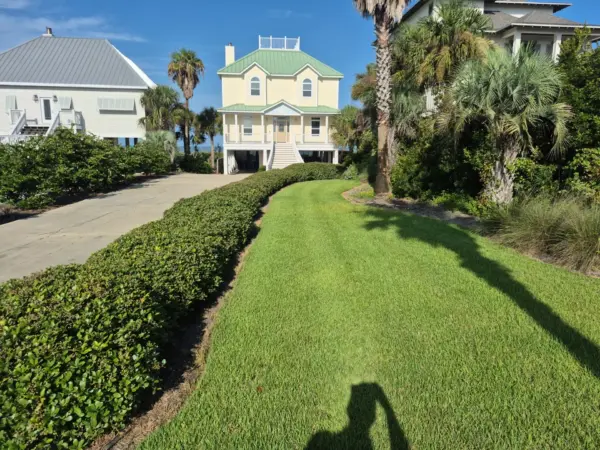
We worked with this homeowner on Cape San Blas in 2020 to help design a landscape that, when paired with routine service would last for years to come! This photo was taken by our crew lead in August of 2026!
Looking for a lower-maintenance landscape for your Florida Panhandle home?
Joe’s Custom Lawn designs, installs, and maintains landscapes throughout Port St. Joe, Mexico Beach, WindMark Beach, Cape San Blas, Indian Pass, and the surrounding areas.
Because our team doesn’t just install landscapes—we maintain them—we can help you think beyond installation day and design a property that makes sense for the way you actually want to use and maintain your home.